
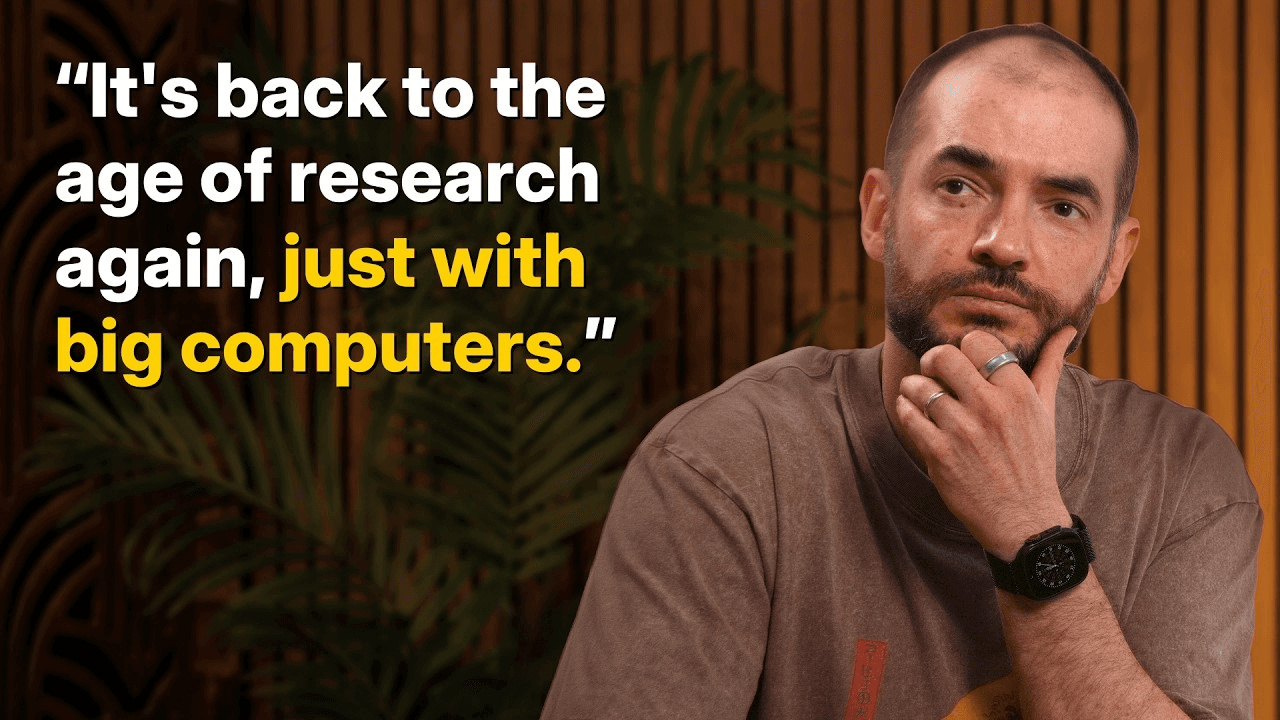
The silence is finally broken. After months of speculation following his departure from OpenAI, the Ilya Sutskever interview has dropped, and it is nothing short of a paradigm shift for the industry.
For the last five years, the AI narrative has been dominated by one word: Scaling. Just add more compute, more data, and bigger parameters, and AGI will emerge. But in this rare, technical deep dive, the founder of Safe Superintelligence (SSI) reveals a startling truth: the low-hanging fruit of AI scaling laws has been picked.
We are entering a new era. The "Age of Scaling" is over; the Age of AI Research has returned.
If you are a technical founder, ML researcher, or investor trying to understand why your LLM benchmarks aren't translating to real-world revenue, this breakdown is for you. We analyzed the full Ilya Sutskever SSI roadmap to explain the AI generalization problem, the limits of RL (Reinforcement Learning), and why the next 5–20 years will look nothing like the last three.
TL;DR: The 5-Second Summary
- Scaling is Stalling: Simply making models bigger (pre-training) is hitting diminishing returns. We are moving from the "Age of Scaling" (2020–2025) back to the "Age of Research" where novel ideas matter more than raw compute.
- The Generalization Paradox: Models are acing difficult benchmarks (evals) but failing at basic, continually evolving real-world tasks. This "disconnect" is the central problem to solve.
- RL Training Limitations: Current Reinforcement Learning makes models "narrow." Like a competitive programmer who memorizes algorithms but can't build a product, RL over-optimizes for specific metrics at the expense of general wisdom.
- The "It" Factor: Humans learn sample-efficiently (e.g., driving in 10 hours) due to biological value functions (emotions) and evolution. AI lacks this "continual learning" capability.
- SSI’s Mission: Ilya’s new company, Safe Superintelligence, is betting on a "straight shot" to superintelligence by solving the technical problem of generalization, rather than releasing incremental products.
Table of Contents
- The "Disconnect": Why High Evals Don't Equal Value
- The End of the Scaling Era
- The "Competitive Programmer" Fallacy
- Human vs. AI Learning: The Sample Efficiency Gap
- What is SSI Building? (The Straight Shot)
- FAQ: Ilya Sutskever & The Future of AI
The "Disconnect": Why High Evals Don't Equal Value
One of the most confusing aspects of the current AI landscape is the AI economic impact gap. We have models that score in the 99th percentile on coding tests, yet they struggle to fix a simple bug in a production environment without introducing two new ones.
In the Ilya Sutskever interview, he explicitly highlights this paradox:
"The models seem smarter than their economic impact would imply... How to reconcile the fact that they are doing so well on evals, but the economic impact seems to be dramatically behind?"
The "Vibe Coding" Loop of Doom
Ilya describes a phenomenon many developers face today:
- You ask the AI to fix a bug.
- It says, "You're right, I found it," and fixes it.
- In doing so, it introduces a second bug.
- You point out the second bug.
- It apologizes and re-introduces the first bug.
This isn't just a hallucination issue; it’s an AI generalization problem. The model has learned to pattern-match against the training data (and likely the evaluation data) but lacks the underlying "value function" to understand the intent of the code base.
Key Insight: If your startup relies solely on public benchmarks to gauge model quality, you are flying blind. Real-world reliability is the new benchmark.
The End of the Scaling Era (Age of Research)
This is the most controversial and critical takeaway. For the last few years, the strategy was simple: Scale.
- Pre-2012: The Dark Ages.
- 2012–2020: The Age of Research (AlexNet, Transformers). People tinkered with architectures.
- 2020–2025: The Age of Scaling (GPT-3, GPT-4). The recipe was found; we just added more ingredients (compute/data).
Ilya argues we are now swinging back.
Why Pre-Training Was "Easy"
During the scaling era, pre-training was a low-risk investment for big tech. You didn't need a brilliant new idea; you just needed a check for $100M in GPUs. You knew that if you doubled the compute, the loss would go down. It was physics.
But data is finite. We have scraped the internet. The next leap in performance won't come from just reading more text—because there isn't much high-quality text left.
The Return to "Schleppy" Research
We are returning to a time where ideas are the bottleneck, not just hardware.
"If you 100x the scale, [things] would be different... but is the belief that if you just 100x the scale, everything would be transformed? I don't think that's true. So it's back to the age of research again."
This is why Ilya Sutskever SSI (Safe Superintelligence) is structured differently. They aren't just building a bigger data center; they are looking for a new paradigm to replace the current Pre-training + RLHF stack.
Table: The Eras of AI Development
| Era | Primary Driver | Risk Profile | Key Innovation |
|---|---|---|---|
| 2012–2020 | Research | High | Architectures (CNNs, Transformers) |
| 2020–2025 | Scaling | Low | Data Volume & Compute Scaling |
| 2025–Beyond | New Research | High | Generalization & Continual Learning |
The "Competitive Programmer" Fallacy
Why do models fail in practice? Ilya offers a brilliant analogy regarding RL training limitations.
Imagine two students:
- Student A (The RL Agent): Practices competitive coding problems for 10,000 hours. Memorizes every proof technique. Knows every edge case of the specific test set. They become the #1 competitive programmer in the world.
- Student B (The Generalist): Practices for 100 hours. They aren't as fast, but they have "it"—intuition, taste, and the ability to learn.
Who has the better career? Student B.
The Over-Optimization Trap
Current AI models are Student A. Through Reinforcement Learning (RL), they are beaten into submission to answer prompts in a very specific, helpful, safe way. But this process narrows their cognitive horizon.
- Pre-training casts a wide net (general knowledge).
- RL Training collapses that net into a specific shape (doing well on evals).
Ilya suggests that this narrowing might be why models act "brain damaged" in novel situations. They have optimized for the test, not for the underlying logic of the world. This is a massive signal for those working on superintelligence alignment—you cannot RLHF your way to a wise machine.
Human vs. AI Learning: The Sample Efficiency Gap
To solve the ai generalization problem, we must look at the ultimate learning machine: the human teenager.
A teenager learns to drive a car in roughly 10 to 20 hours. They do this without crashing thousands of times (mostly). An autonomous vehicle trained via current ML methods needs millions of miles of simulated driving data to achieve similar reliability.
The "Value Function" of Emotions
Why are humans so data-efficient? Ilya proposes a fascinating theory involving ai value function emotions.
Evolution has hard-coded humans with a robust, biological "value function"—our emotions.
- Fear/Pain: Negative reward signal.
- Social Shame: Alignment signal.
- Curiosity: Exploration signal.
These emotions allow us to "short-circuit" learning. We don't need to play the whole game to know we messed up; we feel the mistake immediately.
"Maybe what it suggests is that the value function of humans is modulated by emotions in some important way that's hardcoded by evolution."
For continual learning AI, we need to replicate this. An AI needs to know it's going down a wrong path before it finishes generating the code, akin to a "gut feeling" about a solution. This is likely a core research focus at SSI.
What is SSI Building? (The Straight Shot)
Search interest for Ilya Sutskever SSI is skyrocketing because the company's strategy is contrarian. While OpenAI, Anthropic, and Google are releasing incremental models (GPT-5, Gemini 2) to capture market share, SSI is taking a "Straight Shot."
The "No Product" Strategy
SSI is not releasing a chatbot next week. They are insulating themselves from the "rat race" of product shipping to solve the deep technical blockages of superintelligence.
- Avoid the Market: Market pressure forces you to optimize for short-term revenue (Student A), not long-term generalization (Student B).
- The Convergence: Ilya predicts that eventually, all strategies will converge. Once the "secret" to true generalization is found, every lab will adopt it. SSI aims to find it first.
- Safety via Competence: You cannot align a system that is confused. A model that truly understands what it is doing (generalization) is easier to align than a model that is just mimicking safety behaviors.
Prediction: The 5-to-20 Year Timeline
When asked about the timeline for a human-level learner that becomes superintelligent, Ilya gave a wide but confident window: 5 to 20 years.
This contradicts the "AGI in 2026" hype but also dismisses the skeptics. It acknowledges that we need new physics-level breakthroughs in ML, not just more GPUs.
FAQ: Ilya Sutskever & The Future of AI
What is the "AI Generalization Problem" Ilya discusses? The AI generalization problem refers to the gap between a model's performance on benchmarks (evals) and its utility in the real world. Ilya argues that while models can memorize specific tasks (like competitive coding), they lack the robust "value function" humans possess to adapt to novel, messy situations without making basic errors.
Why does Ilya Sutskever say scaling laws are failing? He suggests we are moving from the "Age of Scaling" back to the "Age of Research." Pre-training on massive datasets faces diminishing returns because high-quality data is finite. Simply adding more compute is no longer enough; we need new paradigms in learning efficiency and reasoning to reach the next level of intelligence.
What is Ilya Sutskever's new company, SSI? Safe Superintelligence (SSI) is a research lab co-founded by Ilya Sutskever. Unlike OpenAI or Anthropic, SSI does not plan to release incremental commercial products. Their goal is a "straight shot" to developing a safe, superintelligent system by focusing entirely on R&D without short-term market pressures.
What is the difference between Pre-training and RL Training? Pre-training involves learning from massive amounts of data to build a general world model (like reading the whole internet). RL (Reinforcement Learning) Training is post-training where the model is "rewarded" for specific behaviors. Ilya compares RL to a student cramming for a specific test—it increases scores but can decrease general adaptability.
What is Ilya Sutskever's prediction for AGI? In his recent interview, Ilya forecasted a timeline of 5 to 20 years for the development of a system that can learn as efficiently as a human and subsequently become superintelligent.
Conclusion: The Era of "Vibe Coding" is Over
The Ilya Sutskever interview serves as a wake-up call. The honeymoon phase of Generative AI—where we were all impressed by basic text generation—is ending.
We are now facing the hard reality of engineering: Reliability. For the last three years, we thought reliability would come from size. It turns out, reliability comes from truth—from models that actually understand the world, rather than just statistically predicting the next token.
For founders and developers, the message is clear: Don't rely on the "scaling fairy" to fix your product's edge cases. The future belongs to those who solve the ai generalization problem, likely through the novel application of value functions and continual learning architectures.
SSI has started the race. Now we wait to see if the tortoise beats the hares.